Why Are Chinese official's hat chairs designed that way? The answer begins with a shape: a broad, level crest rail, upright posts, and arms that turn gently toward the sitter. Known as guanmaoyi, or “official’s hat chair,” this form resembles the winged hats worn by officials, but its proportions also serve practical purposes. The back supports an upright posture, while the open frame lets air move around the body. Small details matter. A rail’s curve can change how the chair feels against the shoulders.
The design belongs to a larger history of Chinese seating and woodworking. Furniture historian Wang Shixiang documented traditional forms and joinery in his scholarship, including Chinese Classic Furniture. For a broader design principle, architect Frank Lloyd Wright once said, “The chair is a very difficult object. A skyscraper is almost easier.” His remark is not about guanmaoyi specifically, but it captures the care required to make a chair both useful and expressive. A chair is never just a silhouette.
Modern furniture reports offer a useful contrast. CSIL’s World Furniture Outlook 2024 tracks production and trade across the global furniture industry; such data describes today’s market, not the historical meaning of one chair form. That distinction matters. A modern maker may reproduce the crest rail but miss the balance, joinery, or human scale that gives the original its character. This introduction examines the chair’s shape, comfort, status, and craft—while treating familiar explanations with care. The hat-like outline is memorable. It is not the whole story.
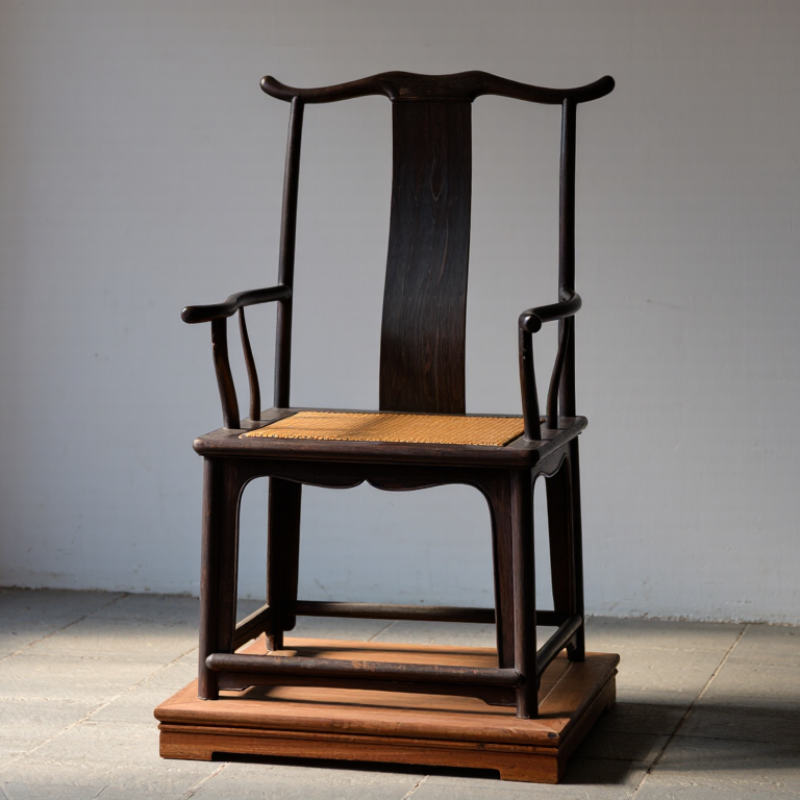
The Chinese official hat chair, or guanmaoyi, is a traditional wooden chair named for its backrest’s resemblance to an official’s headwear. Its defining feature is the top rail, which may extend beyond the uprights like small wings. In some versions, the arms and back form a continuous, graceful line. The design is associated with Ming-style furniture, especially forms developed during the Ming dynasty (1368–1644). Still, a Ming-style chair is not necessarily an original Ming-period piece; later makers continued and adapted the shape.
Its open frame keeps the silhouette light, while the broad seat and curved rails offer practical support. Joinery and proportions matter as much as decoration. The Metropolitan Museum of Art’s collection records provide useful examples for studying historic Chinese furniture, though individual chairs vary. That variation is worth remembering: “official hat chair” describes a family of forms, not one fixed blueprint.
Modern interest in furniture provides context for the chair’s continued appeal. Grand View Research valued the global furniture market at US$677.09 billion in 2023 and projected 5.0% annual growth from 2024 to 2030. This market figure does not measure demand for historic chairs specifically.
Tips: Check the rail shape, joints, and seat proportions together. A single decorative detail cannot establish a chair’s age or authenticity.
The crest rail is the broad top bar, often with ends that project like the wings of an official’s hat. It is not merely decoration. Joined to the rear uprights, it helps keep the back frame aligned and gives the sitter’s upper back a firm contact point. The uprights carry forces from the backrest toward the seat frame. Their joints matter: a loose connection can make the whole back feel unstable. The silhouette is distinctive, but the joinery does much of the real work.
The arms provide a resting surface and can steady a sitter rising from the chair. Their supports transfer pressure into the frame, rather than asking the crest rail to bear it. On many examples, the arms meet the uprights and front supports through carefully fitted joints. Wood movement complicates this. The USDA Forest Products Laboratory’s Wood Handbook reports equilibrium moisture content of about 12% at 70°F and 65% relative humidity; changing humidity can therefore affect fit and stiffness. That figure is a reference condition, not a guarantee for every room. The design explanation can sound tidy. Real chairs vary, and wear or repairs may change how forces travel through them.
Why Are Chinese Official Hat Chairs Designed That Way?
A Chinese official hat chair is recognized by its high back and outward-curving top rails. Its appearance reflects craft and status, but its proportions can also be examined through human measurements. ISO 7250-1 defines basic body dimensions, including stature, sitting height, hip breadth, and popliteal height. It does not prescribe chair dimensions.
Those measurements offer a practical way to ask how a chair meets the body. Seat height can be compared with popliteal height, the distance from the underside of the foot to the knee. Seat depth relates to buttock-popliteal length, while seat width can be considered alongside hip breadth. A high back may support the torso, but its shape alone cannot confirm comfortable support. Try sitting in one. Feet should rest steadily, and the seat edge should not press sharply behind the knees.
There is a limit to this comparison. ISO measurements describe people, not historic furniture, and bodies vary with age, clothing, and posture. A wooden seat does not yield like upholstery. That matters. The chair’s proportions may look balanced, yet still feel rigid during a long sitting. Measurements help explain fit; they cannot replace careful observation or a real sitting test.
Relating seat proportions to human measurements defined in ISO 7250-1
The bars show typical general-purpose chair design ranges, not dimensions prescribed by ISO 7250-1. The standard defines how to measure body dimensions: seat height relates to popliteal height, seat depth to buttock-popliteal length, and seat width to hip breadth. A rigid wooden chair, such as a traditional Chinese official hat chair, makes these proportions especially noticeable. Individual fit depends on the intended users and should be checked against measured body dimensions.
Ranges shown: seat height 400–460 mm; seat depth 380–430 mm; seat width 450–500 mm. ISO 7250-1 specifies measurement procedures and definitions, not these chair design ranges.
Why Are Chinese Official Hat Chairs Designed That Way?
The tall, rounded crest rail gives an official hat chair its recognizable outline. Beneath that silhouette, mortise-and-tenon joints do much of the structural work. A tenon, shaped at the end of one piece, fits into a matching mortise cut into another. The connection is mechanical, not merely decorative.
Where the legs meet the seat rails, well-fitted joints help keep the frame square under a sitter’s weight. Side stretchers connect the legs lower down, limiting sway as the chair is moved or used. The broad crest rail also joins the uprights, helping the back frame resist pressure. No screws are needed. The wood itself carries the load through carefully fitted surfaces.
A craftsperson may test each joint before assembly, checking for gaps or a fit so tight that parts cannot settle properly. Glue can be used, but the joint’s shape remains essential. Wood changes slightly with humidity, so even a skilled maker must allow for movement. That detail is easy to overlook. A chair can look rigid, yet its frame depends on precise connections that accommodate the material rather than forcing it to behave like metal.
Official hat chairs pair a sweeping crest rail with upright posts and a firm seat. That shape is not only decorative; it helps frame the sitter’s back. Assess the chair as wooden furniture under GB/T 3324-2017, a useful reference for checking materials, workmanship, dimensions, and physical performance.
It is a benchmark, not proof of quality by itself.
Look closely. Grain should run consistently across visible parts, while concealed joints deserve equal attention. Check the mortise-and-tenon connections for gaps, glue marks, or movement. Press gently on the seat and back; the frame should feel stable, with no sharp creaks or rocking.
Small details matter. Inspect edges for splinters, finish for bubbles or uneven patches, and contact points for roughness. Compare measured dimensions with the intended design, then consult the standard’s applicable test methods rather than relying on appearance alone. Material declarations and test records can help confirm what the wood and finish actually are.
A chair may look solid yet hide rushed joinery. And a tiny wobble? Worth investigating. Standards guide careful assessment, but skilled hands and consistent inspection still make the difference.
Its tall back and outward-curving crest rail create a distinct silhouette. Appearance alone does not tell you how comfortable it feels.
Compare seat height with popliteal height, the distance from the foot’s underside to the knee. ISO 7250-1 describes body measurements, not chair dimensions.
Seat depth can be considered alongside buttock-popliteal length. Seat width can be compared with hip breadth. These are useful clues, not guarantees.
Keep both feet resting steadily on the floor. The front edge should not press sharply behind your knees. Try it yourself.
No. The back’s shape alone cannot confirm comfortable torso support. A long sitting may reveal stiffness that a quick glance misses.
A shaped tenon fits into a matching mortise. At the seat rails, these joints help keep the frame square under weight.
Lower stretchers connect the legs and can limit sway. The crest rail joins the back uprights, helping the frame resist pressure.
Humidity can make wood change slightly. A craftsperson checks for gaps and an overly tight fit, allowing the parts some movement. Easy to miss.
Why are Chinese official's hat chairs designed that way? Their form combines a distinctive silhouette with practical support. Rooted in Ming-style furniture, the chair is recognized by its raised crest rail, which spans the back, and its upright posts, which carry and stabilize the frame. The projecting arms offer support when sitting or rising, while the seat and back create a balanced, open structure.
Proportions can be considered in relation to human body measurements described in ISO 7250-1, such as seated height and arm reach, helping explain how seat height, depth, and arm position affect comfort. Mortise-and-tenon joints connect the frame’s members without relying solely on surface fasteners, contributing to strength and a clean appearance. Materials, construction, and finish can also be assessed against the quality and safety requirements set out in GB/T 3324-2017, showing how sound craftsmanship supports both durability and the chair’s refined design.

ELDI Home