Moving a heavy solid wood Chinese wardrobe is not a simple furniture task. Its dense timber, tall frame, glass panels, and uneven weight distribution create serious handling risks. A wardrobe may look stable, yet its center of gravity can shift when doors or drawers move. One careless tilt can damage flooring, loosen joints, or injure a helper.
The UK Health and Safety Executive reported 543,000 workers with work-related musculoskeletal disorders in 2023/24, causing 7.8 million lost working days. Manual handling remains a practical workplace concern, not merely a household inconvenience. The NIOSH Lifting Equation also shows that lifting risk depends on load weight, reach distance, twisting, frequency, and grip quality. These factors matter when navigating narrow corridors or stair landings. How to move heavy solid wood Chinese wardrobes safely? The answer begins with planning, not force.
This guide applies professional moving principles to traditional wardrobes. It recommends measuring doorways, removing shelves and drawers, protecting corners, and using rated moving equipment. A furniture dolly, lifting straps, corner protectors, and non-slip gloves can reduce unnecessary strain. At least two trained adults should control the wardrobe, while one person directs movement. Keep it upright when the manufacturer’s construction allows. Never drag it across bare flooring. Still, some older wardrobes contain hidden nails, fragile joints, or poorly balanced bases, so a visual inspection may not reveal every risk. I would not treat a general weight estimate as reliable. When stairs, glass, severe imbalance, or unusually valuable craftsmanship are involved, a qualified furniture-moving professional is the safer choice.
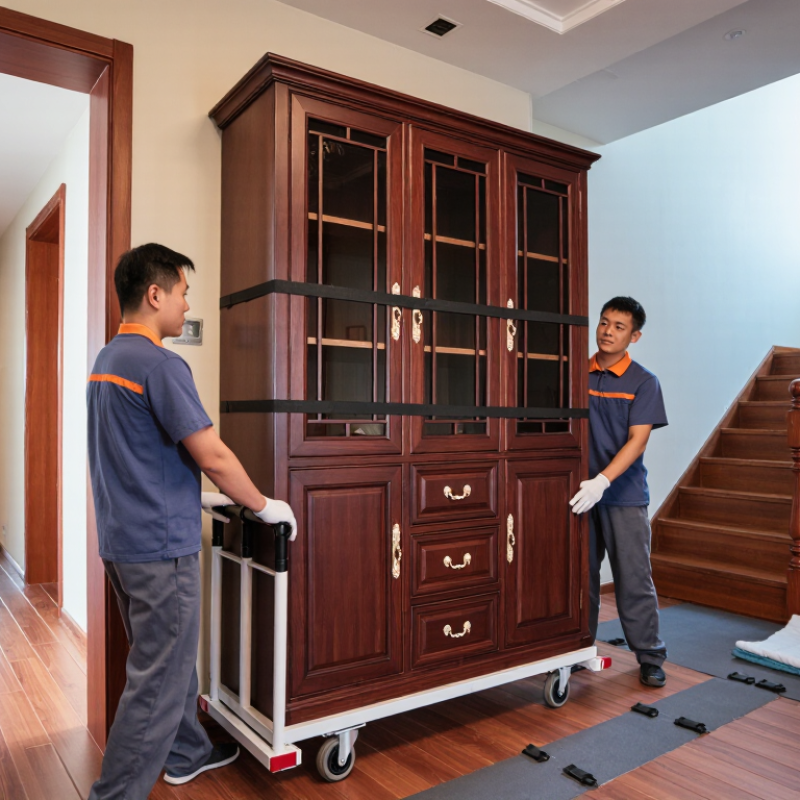
What Is the Safest Way to Move Heavy Solid Wood Chinese Wardrobes?
Assess the wardrobe before touching it. Weigh it if possible, or estimate from its dimensions and solid-wood construction. The U.S. NIOSH Revised Lifting Equation uses a 51-pound load constant only under ideal conditions. Handles, distance, twisting, and frequency reduce that value quickly. A large wardrobe may exceed safe manual-handling limits, even when two adults can briefly lift it.
Find the center of gravity by checking where shelves, drawers, and doors sit. Remove every loose part first. Keep doors secured, but do not tape delicate lacquer directly. Tilt the wardrobe slightly and observe whether it pulls forward. That small test can reveal hidden instability. HSE’s 2023/24 workplace data attributes 17% of non-fatal injuries to handling, lifting, or carrying. Route hazards matter equally. Measure doorways, stair turns, ceiling height, and floor strength. Look for rugs, wet tiles, thresholds, and narrow landings. I would not trust a route judged “probably clear.”
Tips: Use a furniture dolly, wide straps, corner padding, and at least three trained people for a tall cabinet. One person should direct movement. Move slowly. Stop at every turn. Never carry it by decorative trim or thin legs. A professional mover should inspect the route when stairs, fragile flooring, or uncertain weight are involved. Mistakes often begin with rushed measurements.
The chart estimates the mass of a 0.30 m³ solid-wood wardrobe shell using representative oven-dry wood densities. Actual weight can be higher because of moisture, doors, shelves, metal fittings, glass, and stored contents.
Before moving the wardrobe, measure its real weight, identify the heaviest side to locate the center of gravity, secure all doors and drawers, and check doorway width, stair turns, floor strength, overhead clearance, and slip hazards. Use enough trained movers and mechanical assistance for the measured load.
Moving a solid wood Chinese wardrobe safely begins with measurement, not muscle. The NIOSH Lifting Equation uses a 23 kg load constant, but this is not a recommended default weight. It represents an ideal two-handed lift under controlled conditions. The recommended weight limit is calculated as RWL = LC × HM × VM × DM × AM × FM × CM. Each multiplier reduces the limit when the wardrobe is bulky, distant, twisted, frequent, or difficult to grip.
A wardrobe may weigh 80 kilograms or more. Its narrow handles, uneven back, and shifting shelves can create dangerous leverage. Empty every drawer and remove loose shelves first. Measure the horizontal reach from the body to the load. Check the starting and ending heights, then record the turning angle and lifting frequency. A large wardrobe carried around a stair landing should receive a much lower assessment than a compact box lifted near waist height.
Do not divide the total weight casually among four people. Their positions, grip quality, timing, and visibility may differ. Use a smooth path, protective floor covering, and stable lifting straps designed for the task. One person should give clear movement commands. I once underestimated how much a small turn changed the load on my back; the equation exposed that mistake, but it still could not replace a site inspection. When the calculated limit remains uncertain, mechanical assistance or trained movers is the more reliable choice.
Moving a solid wood Chinese wardrobe safely starts with reducing its top weight. Remove every shelf, drawer, and loose fitting before lifting. Wrap shelves separately, because one sliding panel can injure a foot. Keep doors closed, then secure them with soft straps, not brittle tape. If doors can be removed safely, label each hinge and store the panels flat. This follows the stability logic behind ASTM F2057: less shifting mass means lower tip-over risk. It is guidance, not a moving certification.
Measure doorways, corridors, and turning spaces before the wardrobe leaves the room. Use two or more capable people for lifting. A sturdy furniture dolly should support the base, while straps control the upper frame. Keep the cabinet upright whenever possible. Never pull it by a door, handle, or decorative carving. On stairs, stop and reassess the route. Small errors become dangerous quickly.
After placement, inspect the feet, back panel, doors, and floor contact points. Install an anti-tip restraint suited to the wall construction and the wardrobe’s weight. Follow the restraint instructions carefully. A weak wall connection can create false confidence. Test each door and drawer slowly before returning the shelves. One detail is easy to miss: an empty wardrobe may still shift on an uneven floor. Recheck its level, spacing, and restraint after loading. Careful work can still need correction.
| Move Stage | Recommended Action | Safety Purpose | Verification Before Continuing | ASTM F2057 Tip-Over Principle |
|---|---|---|---|---|
| 1. Plan the route | Measure the wardrobe, doorways, stair landings, elevator, and final location. Protect corners and remove loose obstacles from the path. | Prevents collisions, sudden stops, and uncontrolled changes in direction. | The full route has enough width, height, turning space, and load-bearing capacity for the wardrobe and moving equipment. | Stable placement and controlled movement reduce conditions that can initiate tip-over. |
| 2. Empty the unit | Remove all clothing, drawers, shelves, shelf pins, removable rods, and other loose components. Keep hardware in labeled bags. | Reduces total weight and prevents internal parts from shifting or falling during handling. | The cabinet is empty, and every removable component is separately secured. | Removing movable contents helps maintain a low, predictable center of gravity. |
| 3. Secure the doors | Close each door and secure it with non-abrasive straps or protective wrap. Do not rely on a lock, latch, or loose tape alone. | Prevents doors from swinging open, striking people, or shifting the cabinet’s balance. | Doors cannot open during tilting, lifting, rolling, or turning. | Unrestrained front components can change the center of gravity and increase forward movement risk. |
| 4. Protect the finish | Cover carved panels and finished surfaces with moving blankets or padded material. Place padding between straps and the wood. | Protects lacquer, veneer, carving, and hardware from abrasion and compression marks. | Straps contact padding rather than delicate decorative surfaces or glass. | Protection allows firm restraint without damaging components that could later affect stability. |
| 5. Use suitable equipment | Use a rated furniture dolly, appliance dolly, lifting straps, corner protectors, and a ramp where needed. Select equipment for the measured load and terrain. | Transfers the load safely and reduces manual lifting, twisting, and sudden slips. | Equipment capacity exceeds the actual loaded weight, and wheels, straps, and brakes are undamaged. | Controlled support helps prevent unintended tipping during transport. |
| 6. Coordinate the lift | Use at least two trained adults for a large solid-wood wardrobe; assign one person to direct movement. Lift with legs and keep hands away from pinch points. | Improves communication and reduces crush, strain, and loss-of-control hazards. | Everyone understands the commands: “lift,” “stop,” “lower,” and “clear.” | Predictable, coordinated handling minimizes sudden force and instability. |
| 7. Keep it upright | Move the wardrobe upright whenever practical. If it must be tilted, keep the tilt controlled, support the upper section, and never leave it unattended. | Limits structural stress and reduces the chance of the cabinet falling forward or sideways. | The wardrobe is stable before each turn, threshold crossing, or change in slope. | Tip-over risk increases when the center of gravity moves beyond the support area. |
| 8. Position on a level surface | Place the wardrobe on a firm, level floor. Do not use loose objects as improvised shims; use stable leveling components suitable for the furniture. | Prevents rocking, sliding, and uneven loading of the base. | The cabinet does not rock when gently tested from the sides and front. | A stable base is essential to resisting forward and lateral tip-over. |
| 9. Anchor after placement | Anchor the wardrobe to a structural wall member or an appropriately rated wall anchor using an anti-tip restraint. Follow the restraint manufacturer’s installation instructions. | Restricts forward rotation if a door is opened, weight shifts, or the unit is bumped. | The restraint is tight, correctly attached to the cabinet and wall, and free from visible damage. | ASTM F2057 principles emphasize anchoring clothing-storage furniture to reduce tip-over hazards. |
| 10. Reinstall components | Reinstall shelves, rods, drawers, and hardware only after the cabinet is stable and anchored. Keep heavy items on lower shelves. | Maintains a lower center of gravity and prevents the cabinet from becoming front-heavy. | Shelves are fully seated, pins are engaged, drawers close properly, and doors do not bind. | Lower and evenly distributed loading improves resistance to forward instability. |
| 11. Final safety check | Test the doors and drawers individually, confirm the anchor remains secure, and keep children from climbing or hanging on the furniture. | Identifies movement or restraint problems before normal use. | No rocking, sliding, loose hardware, opening restraint, or interference is present. | Safe use depends on both secure installation and prevention of climbing-related forces. |
Moving a heavy solid wood Chinese wardrobe safely starts with the dolly, not brute strength.
Its rated capacity must exceed the wardrobe’s total moving weight. Include drawers, shelves, hardware, and anything left inside. Solid wood can weigh far more than its appearance suggests. I prefer a generous margin instead of working near the stated limit. A 300-kilogram wardrobe needs a dolly rated clearly above 300 kilograms.
Empty the wardrobe completely before lifting it. Remove detachable shelves and doors when their fittings allow it. Wrap corners with thick moving blankets to prevent dents and slipping. Place the furniture dolly beneath the strongest, broadest section of the base. Keep the wardrobe centered, then secure it with two strong straps. Do not rely on one strap. Inspect the wheels and platform for cracks before movement.
Tall wardrobes have a high center of gravity. Keep them upright whenever possible, and avoid sudden turns. One person should guide the route while others control the load. Move slowly over thresholds and uneven flooring. Never pull from a door, handle, or carved panel.
I once underestimated how much extra weight a few shelves could add. That mistake changed my preparation process. Measure doorways, clear rugs, and check the path before the wardrobe leaves the wall. A narrow corner can defeat an otherwise suitable dolly.
Moving a solid wood Chinese wardrobe requires control, not brute strength. Two trained people should inspect the route before touching the cabinet. Measure stair width, ceiling clearance, landings, and threshold height. Remove loose shelves, drawers, and doors when this reduces weight safely. Keep hardware in a labeled bag.
One person leads from the higher side of the stairs. The second person supports the lower side and watches each step. Agree on short commands, such as “lift,” “stop,” and “lower.” Move one step at a time. Keep the wardrobe close to the body, but never trap fingers against walls. Use a rated stair dolly, padded straps, and a temporary threshold ramp where suitable. Do not twist while carrying. Stop if the cabinet shifts.
The UK Health and Safety Executive reported 543,000 workers with work-related musculoskeletal disorders in 2023/24, causing 7.8 million lost working days. Its manual-handling guidance emphasizes reducing load weight, improving routes, and using mechanical assistance. These principles apply to residential furniture too. The process is not perfect; narrow landings can expose poor planning. If the wardrobe cannot be controlled by two people, use a trained moving team.
Tips: Photograph the route first. Check floor protection. Keep both carriers’ hands visible. Never rush a staircase. Thresholds need a level approach.
No. It represents an ideal two-handed lift under controlled conditions. A bulky wardrobe requires a lower calculated limit.
Use RWL = LC × HM × VM × DM × AM × FM × CM. Each multiplier reduces the limit for distance, height, twisting, frequency, or grip difficulty.
Empty every drawer. Remove loose shelves, doors, and hardware when possible. Even small shelves can add surprising weight.
Its center of gravity sits high. Sudden turns, uneven floors, and narrow corners can make it tip or shift.
Choose a dolly rated clearly above the wardrobe’s complete moving weight. Include drawers, shelves, fittings, and remaining contents.
Center it over the strongest base section. Use two strong straps, not one. Protect corners with thick moving blankets.
Not automatically. Their positions, grip, timing, and visibility may differ. Shared lifting still needs clear commands and coordinated movement.
Measure doorways and the turning route. Remove rugs, cover floors, inspect wheels, and clear every threshold.
No. It cannot replace a site inspection. I once underestimated a small turn, and the back strain felt much greater.
Use mechanical help or trained movers when the weight, route, grip, or calculated limit remains uncertain. Slow movement matters.
How to move heavy solid wood Chinese wardrobes safely? Begin by estimating the wardrobe’s total weight, identifying its center of gravity, and inspecting the entire route for narrow passages, uneven flooring, stairs, thresholds, and overhead hazards. Remove all shelves, drawers, and loose contents to reduce weight and prevent shifting. Doors should be closed, padded, and securely fastened so they cannot swing open during movement. A basic lifting assessment, informed by the NIOSH Lifting Equation and its 23 kg load constant, can help determine whether the task exceeds safe manual-handling limits.
Use a heavy-duty furniture dolly rated well above the wardrobe’s combined moving weight, and keep the load balanced and strapped during transport. On stairs or raised thresholds, use trained two-person handling procedures, clear communication, and controlled movements rather than sudden pulling or twisting. Never rush, lift beyond individual capacity, or allow hands and feet beneath an unstable load. If the wardrobe cannot be moved while remaining stable and manageable, professional assistance and suitable lifting equipment should be arranged.

ELDI Home