How to tell if your Chinese furniture is real antique? The answer rarely rests on one dramatic feature. A carved dragon, dark finish, or old-looking brass fitting can be misleading on its own. Look instead at how the piece was made and how its parts have aged together. Check the joints beneath the tabletop, the drawer runners, the back panels, and the undersides of the feet. Hand-cut joinery may show small, consistent variations. Wear should make sense: feet may be rubbed where they touched the floor, while protected corners often retain more finish.
Chinese furniture scholar Wang Shixiang’s research offers a useful way to think about the task. A practical paraphrase of his approach—not a verbatim quotation—is: “Judge the whole piece, not a single clue.” That distinction matters. Later repairs, replacement hardware, and restored surfaces can appear on genuinely old furniture, while convincing artificial aging can imitate wear. Even experienced specialists may disagree about a piece’s date or originality. That uncertainty is worth acknowledging.
In the sections ahead, we’ll examine materials, construction, patina, hardware, and provenance, then consider when an independent appraisal is sensible. Use a flashlight to inspect hidden surfaces, photograph details, and compare them with reliable references. Don’t rush. A close inspection can reveal useful evidence, but no checklist can authenticate every object.
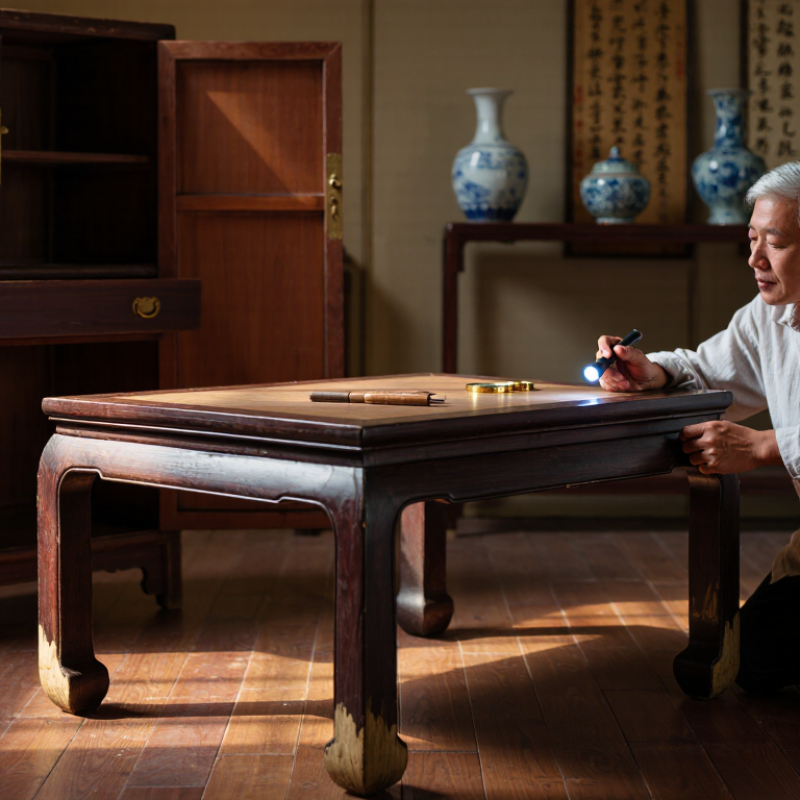
To qualify as an antique Chinese furniture piece, age is a useful starting point, not a complete verdict. In many collecting contexts, “antique” means roughly 100 years old, though definitions can vary by market and jurisdiction. A Chinese-inspired shape alone does not establish age or origin. A cabinet made recently with traditional proportions may be well crafted, but it is not an antique.
Look closely at how the piece was made. Older furniture often has mortise-and-tenon joints, hand-worked surfaces, and wear in places consistent with regular use, such as drawer edges or the underside of a stretcher. These clues need to agree. Artificially aged wood can show dark color without the uneven oxidation, small repairs, and softened edges expected from long use. That matters. Timber identification can also be difficult, especially after staining or restoration.
Age, origin, and condition are separate questions. A piece may be genuinely old but repaired, altered, or assembled from older components. Ask for dated ownership records, clear photographs of joints and hidden surfaces, and a written account of repairs. No single test is perfect. I would be cautious about treating one detail, such as a traditional joint, as proof. Even experienced examination can leave room for doubt.
A Chinese cabinet’s ownership history can be more revealing than its polished surface. Ask for dated invoices, estate inventories, old photographs, and export or insurance records where available. Compare each document’s description with the piece: wood type, dimensions, drawer layout, repairs, and distinctive grain patterns. A 1960s photograph showing the same replaced foot may support a credible timeline. It does not prove the cabinet’s age by itself.
Look for gaps and contradictions. Names, dates, and locations should connect without relying on a single handwritten note. Check whether family records match auction or exhibition catalogues, and ask an independent furniture specialist to assess the documents alongside construction and wear. The Art Basel and UBS Global Art Market Report 2024 estimated 2023 art-market sales at $65 billion; it covers art broadly, not Chinese furniture specifically. Still, that scale underlines why careful records matter in high-value collecting. Paper can mislead. A missing receipt is not automatic proof of a fake, but confident claims without supporting evidence deserve scrutiny. Keep copies of every record, and note what remains uncertain.
How to use this timeline: Compare dated ownership records—such as inventories, bills of sale, estate documents, or old photographs—with the period a piece is claimed to come from. These historical dates provide context, not proof of a furniture’s age or authenticity. A credible provenance should form a consistent ownership history and agree with the object’s construction, materials, and style.
Period dates shown: Ming dynasty (1368–1644), Qing dynasty (1644–1912), and Republican era on mainland China (1912–1949).
When assessing Chinese furniture, begin with the wood, but do not rely on color alone. Age, sunlight, cleaning, and later coatings can all change a surface. Look at hidden areas beneath a seat or inside a drawer. The grain should continue naturally, while end grain and joints may reveal whether parts were replaced. A dark finish is not proof of age. Smell and touch can offer clues, but they are subjective.
Examine how the pieces meet. Traditional mortise-and-tenon joints often fit snugly without visible metal fasteners, though repairs and regional styles vary. Check drawer corners, stretchers, and the underside of a tabletop with a flashlight. Fresh, bright wood inside an old-looking joint may suggest later work. So can evenly spaced machine marks. Yet hand tools were used across many periods, and old furniture can be repaired. One clue is never enough.
Construction should feel coherent. Compare wear on exposed edges with wear in protected corners; a sharp contrast deserves closer attention. Gently test for looseness, but avoid forcing a joint that may be fragile. I would not call a piece antique from patina alone. Even careful inspection has limits. For valuable or uncertain furniture, ask a qualified specialist to assess the materials and construction in person.
Patina is more than a dark surface. Look closely at corners, carved recesses, and areas protected from hands. A convincing age-related finish often changes gradually, with softer color where light and touch have reached the wood. Check the underside, too. If it looks strikingly fresh beside a worn top, ask why. Patina can be recreated, so appearance alone cannot establish age.
Wear should make sense for the furniture’s use. On a chair, inspect the arms, seat rails, and feet for smooth, uneven contact marks. On a cabinet, look around handles and door edges. Real wear is rarely perfectly balanced. Still, a scratch or rounded edge is not proof; damage can be added, and old furniture can be carefully restored. I would avoid treating any single clue as a verdict.
Watch for modern alterations. Phillips-head screws, bright machine-cut surfaces, and fresh glue may point to later repairs, though repairs do not automatically make a piece inauthentic. Compare exposed joints with sheltered ones. Do the tool marks and finish seem consistent? Look for new wood plugs, replaced panels, or abrupt color changes. Take clear photographs and note what is uncertain. That hesitation matters. For a valuable or complex piece, ask an experienced furniture conservator to examine it in person.
How to Tell If Chinese Furniture Is a Real Antique?
Compare Period Features and Seek Expert Authentication
A convincing antique is more than dark wood or worn edges. Compare its joinery, proportions, carving, and hardware with documented examples from the period and region it is said to come from. Hand-cut joints may show slight variation, while machine-made parts often look unusually uniform. Still, construction methods changed over time, and later repairs can blur the clues.
Look closely at the wear. Uneven fading near handles, softened corners, and old repairs may fit years of use, but none proves age by itself. I would not judge a piece by color alone; that can be misleading. Ask a qualified furniture specialist to inspect the wood, finish, joints, and hardware together. Share clear photographs and any ownership records. For a valuable piece, seek an independent second opinion before buying.
Tips: Check the underside, drawer interiors, and back for consistent construction and signs of repair. Request a written assessment that explains its evidence and uncertainty. Be cautious when a seller offers only a confident story, with no supporting details.
| What to Examine | Features Consistent with Older Furniture | Warning Signs or Limitations | How to Check |
|---|---|---|---|
| Period and design | Ming-dynasty furniture (1368–1644) is often associated with restrained forms and carefully proportioned frames. Qing-dynasty furniture (1644–1912) can include more elaborate carving and ornament, though styles varied by region and use. | A style resemblance does not establish age. Later pieces may reproduce earlier designs, and authentic furniture from the same period can differ considerably. | Compare the whole piece—proportions, construction, decoration, and intended function—with well-documented examples from the proposed period. |
| Wood and materials | Traditional furniture may be made from hardwoods such as huanghuali or zitan, as well as other locally available woods. Grain, density, and color can provide useful clues when assessed together. | Wood identification by color or appearance alone is unreliable. Staining, surface treatments, repairs, and replacement parts can obscure the original material. | Ask a qualified specialist to assess the wood and inspect hidden or unfinished areas. Avoid destructive sampling without professional advice. |
| Joinery and construction | Traditional Chinese furniture commonly uses wooden joinery, including mortise-and-tenon connections, and may rely on fitted components rather than visible nails. | Joinery techniques continued over long periods and are still used today. Modern construction or later repairs may also be concealed. | Check joints, undersides, drawer interiors, and the back of the piece for consistent workmanship. Have an expert inspect the structure without forcing joints apart. |
| Surface and wear | Long use may produce wear in areas that are handled or rubbed repeatedly, such as edges, armrests, and drawer pulls. A naturally aged surface can show variation rather than uniform distress. | Artificial distressing can imitate wear. A shiny finish or an evenly worn appearance alone cannot confirm or rule out age; refinishing can also change the surface. | Look for wear that makes sense for the furniture’s use and examine protected areas for a consistent history of aging, repairs, and finish. |
| Hardware and fittings | Metal fittings may show age-related wear and may have been replaced or repaired during the furniture’s life. Their design and attachment can help inform an assessment. | Old-looking hardware can be added to a newer piece, and original fittings may be missing from an authentic antique. | Check screw or nail holes, attachment points, and the condition of the wood beneath fittings. Consider hardware as one clue, not a standalone test. |
| Repairs and alterations | Antique furniture can have a long history of repairs, replacements, and refinishing. Documented, well-executed repairs do not automatically make a piece inauthentic. | Extensive replacement of important structural or decorative elements can affect a piece’s originality and value. Sellers may not know the full repair history. | Request details and photographs of repairs. Ask an independent specialist to distinguish original components from later work. |
| Provenance and documentation | A credible ownership history, dated photographs, estate records, or earlier sale documentation can support an attribution when consistent with the object itself. | An undocumented story or a label attached to the furniture is not proof of age or origin. | Check that records clearly relate to the specific piece and compare their descriptions with its features and condition. |
| Expert authentication | A careful assessment considers design, materials, construction, surface, condition, repairs, and provenance together. Written opinions should explain the basis and limits of the attribution. | No single visual feature or quick online opinion can reliably establish authenticity. Avoid relying only on an interested seller’s claim. | Consult an independent specialist in Chinese furniture before purchase. Provide clear photographs and request an in-person examination when practical. |
Note: These features are useful comparison points, not a definitive dating test. Authenticity and age should be assessed from the evidence as a whole.
Many collectors use roughly 100 years as a guide. Definitions vary, so age alone is not enough.
No. A recently made cabinet can copy traditional proportions. Appearance alone proves little.
Check mortise-and-tenon joints, drawer corners, stretchers, and hidden surfaces. Use a flashlight. Look for bright wood or evenly spaced machine marks.
No. Sunlight, cleaning, and coatings can change a surface. Dark finish is only one clue.
Look for dated invoices, old photographs, estate inventories, and insurance records. Compare dimensions, repairs, and distinctive grain patterns.
A missing receipt does not prove a piece is fake. Contradictions still deserve careful questions.
Compare exposed edges with protected corners. Fresh wood inside an old-looking joint may suggest later work.
Test gently, and never force a fragile joint. For valuable pieces, seek an in-person specialist. Inspection has limits.
How to tell if your Chinese furniture is real antique? Begin by understanding what qualifies as an antique, including its likely age, style, and historical context. Then trace the piece’s provenance, such as previous ownership, family records, or other documentation. A clear history can support an age assessment, though it should be considered alongside the furniture itself.
Examine the materials, joinery, and construction methods for features consistent with the period the piece is said to come from. Look closely at the patina and patterns of wear: natural aging tends to appear gradually, while unusually uniform finishes or signs of recent alteration may call for closer scrutiny. Compare its design and structural details with known period examples, and consult a qualified specialist when uncertainties remain. No single clue proves age on its own; a careful evaluation of history, craftsmanship, condition, and expert opinion offers the most reliable overall picture.

ELDI Home